

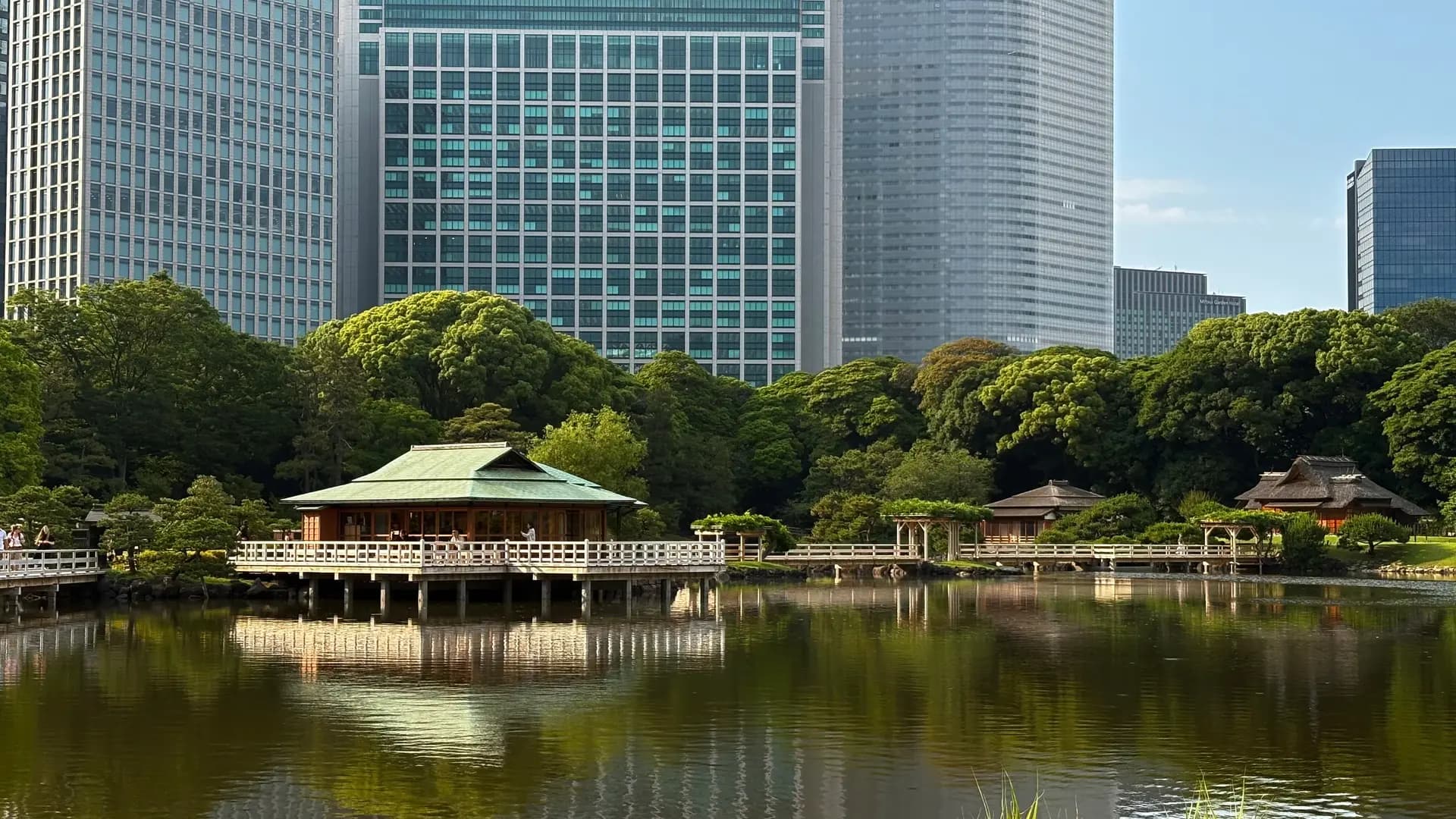
Hama-rikyu Gardens is one of Tokyo’s most representative daimyo gardens from the Edo period, featuring a seawater pond and two traditional duck-hunting grounds.
The Seawater Pond That Changes with the Tide
The seawater pond is a garden style in which seawater is drawn into the pond, allowing its scenery to change with the rise and fall of the tide.
This style was once commonly used in seaside gardens. Other gardens such as Kyu-Shiba-rikyu Gardens, Kiyosumi Garden, and Kyu-Yasuda Garden also originally had seawater ponds.
Today, however, Hama-rikyu Gardens is the only garden in Tokyo where seawater still actually flows in and out of the pond.
From Shogunal Falconry Grounds to Kofu Beach Residence
Until the Kan’ei era(1624–1644), this area was used as falconry grounds by the Tokugawa shogunate.
At the time, it was a vast waterside landscape covered with reeds.
In 1654, Matsudaira Tsunashige, the younger brother of the fourth shogun Tokugawa Ietsuna, received permission from the shogun to reclaim land from the sea and build a villa.
This residence became known as the Kofu Beach Residence.
Becoming the Shogun’s Villa, Hama-goten
Later, Tsunashige’s son, Tsunatoyo, became the sixth shogun, Tokugawa Ienobu.
Following this, the Kofu Beach Residence became a villa of the shogunal family and was renamed Hama-goten.
Over the generations, successive shoguns carried out various landscaping and renovation works. By the time of the eleventh shogun, Tokugawa Ienari, the garden had largely taken on its present form.
From Imperial Villa to Public Garden
After the Meiji Restoration, Hama-goten became an imperial villa and was renamed Hama-rikyu.
Later, the Great Kanto Earthquake and the damage of World War II destroyed valuable buildings, including teahouses, and caused serious damage to the garden’s trees.
On November 3, 1945, Hama-rikyu was granted to the Tokyo Metropolitan Government.
After restoration work, it opened to the public as a paid garden in April 1946.
Designated as a Special Place of Scenic Beauty and Special Historic Site
In December 1948, Hama-rikyu Gardens was designated as a national Place of Scenic Beauty and Historic Site.
In November 1952, including the surrounding water areas, it was further designated as both a Special Place of Scenic Beauty and a Special Historic Site.
A Garden That Preserves the Memory of Edo’s Waterfront
Born on the waterfront of Edo, Hama-rikyu Gardens has served as a shogunal villa, an imperial retreat, and finally a public garden open to everyone.
Located in the heart of Tokyo, it remains one of the city’s most important historic gardens, preserving the memory of Edo’s waterfront landscape into the present day.