

About this garden
Kyu Asakura House was built in 1919 as the private residence of Torajiro Asakura, who served as chairman of the Tokyo Prefectural Assembly and later the Shibuya City Assembly. The property uses the southwest slope of Sarugakucho, with the main house, storehouse, garden gate, and auxiliary building arranged across the site. The main house and storehouse are designated as Important Cultural Properties of Japan.
The garden can be understood in three parts: the front garden near the entrance, the main garden spreading across the south side of the property, and a small inner courtyard. The main garden is especially distinctive because it follows the cliff line of the Nishi-Shibuya Plateau, using the slope and upper flat area to create a strolling garden whose views change as you walk. Historically, the design also incorporated borrowed scenery, including views toward Mt. Fuji, the Meguro River, and the surrounding rural landscape.
What to look for
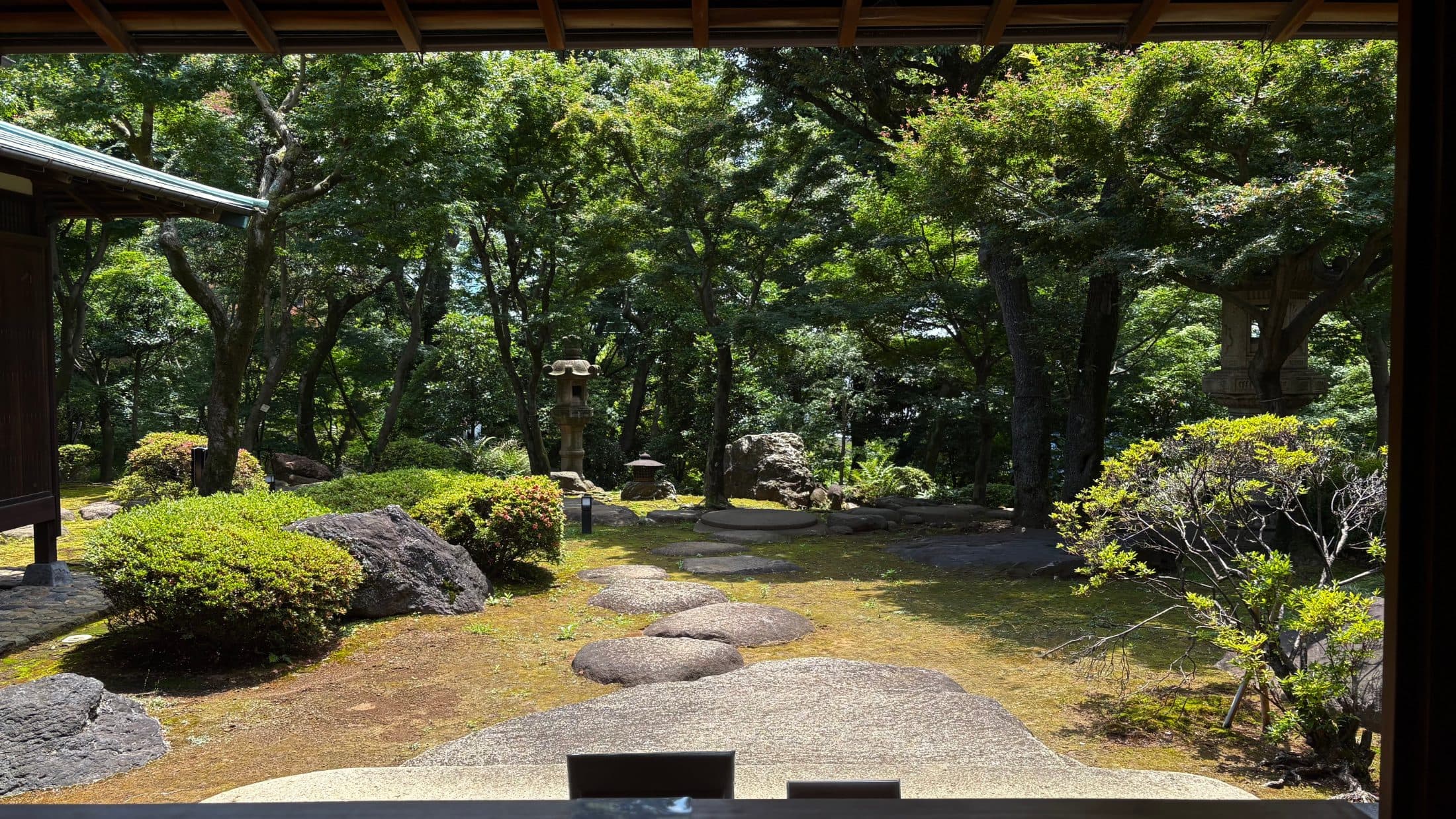
From the main house, the garden is composed almost like a framed painting. After seeing the tatami rooms, transoms, sliding doors, and painted wooden panels, look back toward the garden to feel how the architecture and landscape were designed as one experience.
In the garden, notice the paths that use the height difference of the cliff line, the traces of a stream and small waterfall once fed by the Mita Aqueduct, and the stonework made with rounded stones from Izu and Nebukawa stone. Stone lanterns, landscape rocks, and the restored garden gate also help create depth and rhythm throughout the site.
Seasonally, the garden is known for azaleas in spring and maples in autumn. Its original planting concept was a woodland-like scene, with Japanese red pine as a main tree, supported by maples, Japanese chinquapin, Japanese white oak, and other evergreens.
From a gardener’s perspective
The strength of this garden is that it does not flatten the land. Instead, the cliff line becomes the structure of the design. The garden asks visitors to move through a slope, frames views from the rooms, and uses stone lanterns and landscape rocks to create depth within a compact urban site.
The watercourse also shows a careful sensory design: gravel was mixed into parts of the mortar on the channel bed to create the sound of flowing water. This makes the garden interesting not only visually, but also through sound and movement. Today, the planting has changed due to tree loss, self-seeded growth, and the enlargement of mature trees, but preservation work continues with the aim of bringing the garden closer to its original character.