

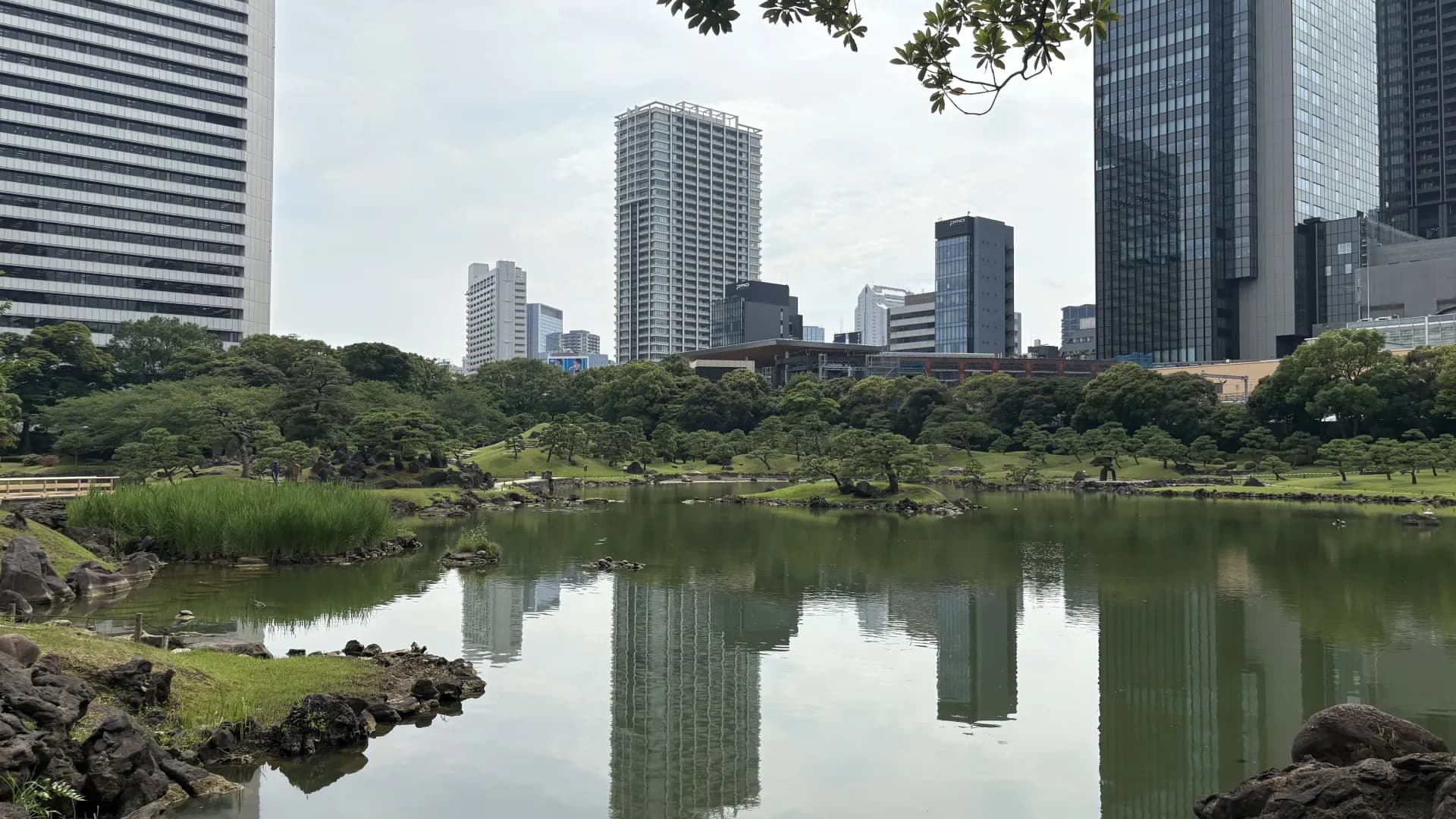
A feudal lord's garden built on former sea
Beside Hamamatsucho Station lies a quiet landscape shaped by water, stone, and pine. Kyu-Shiba-rikyu Gardens is one of Tokyo's surviving early Edo-period feudal lord gardens, alongside Koishikawa Korakuen.
The site was originally part of the sea. After reclamation in the mid-seventeenth century, the land was granted in 1678 to Okubo Tadatomo, a senior official of the Tokugawa shogunate. Gardeners are said to have been brought from his domain in Odawara to create a residence and garden known as Rakujuen.
Designed as a strolling pond garden, it reveals a changing sequence of views as visitors circle the water. The estate later passed through several owners, became a residence of the Kishu Tokugawa family, and then belonged to the Arisugawa imperial family. In 1876 it became the Shiba Detached Imperial Villa.
The Great Kanto Earthquake of 1923 caused severe damage to its buildings and trees. The grounds were transferred to the City of Tokyo the following year, restored, and opened to the public in April 1924. In 1979, the garden was designated a national Place of Scenic Beauty.
A garden where stone commands attention
A large pond known as Sensui forms the center of the garden. Yet the strongest impression comes not from the water alone, but from the stones surrounding it.
Stone-lined shores, islands, stepping stones, and a dry waterfall work together with the curves of the paths and the slopes of the garden. Rather than functioning as isolated ornaments, they create a powerful rhythm across the entire landscape.
Around the central island, stones of different sizes are arranged with a deliberate tension—neither overly ordered nor completely wild. Their composition suggests mountains, rocky coasts, and distant terrain compressed into a limited urban site.
Traces of the sea
Sensui was once a tidal pond connected to seawater. It is now freshwater because of later reclamation around the garden, but the shoreline composition still preserves memories of the sea.
A sandy-style shore, small islands, and carefully placed rocks transform the pond into a miniature ocean landscape. Walking around it feels like traveling through condensed geography: coast, island, mountain, and valley reduced to the scale of a garden.
Look down toward the stones and the surface of the water. Although trains and towers remain close, a small shift in attention can move the scene from modern Tokyo back toward the Edo period.
A Japanese garden that does not hide the city
Modern towers and railway infrastructure rise behind the garden. Kyu-Shiba-rikyu cannot completely screen out the contemporary city—and that contrast has become part of its identity.
Office buildings appear beyond black pine branches. Reflections of the skyline pass across the pond. Trains move behind arrangements of stone created centuries earlier. Edo and present-day Tokyo occupy the same frame.
The site has changed from sea to reclaimed land, from a daimyo residence to an imperial villa, and finally to a public garden within one of the world's largest cities. This visible layering of time is one of its most distinctive qualities.
Walk the circuit slowly
The garden is compact and can be seen in about thirty minutes, but it rewards a slower pace. Circle the pond and view the same stones from several directions.
Begin at Sensui, continue toward the shore and views of the central island, then climb toward the garden's higher ground and dry waterfall. Before leaving, look back across the pond. The stones, islands, and open water will align differently from the first view.
Kyu-Shiba-rikyu is not a garden of grand architecture or deep woodland. Its language is more concentrated: pond, stone, path, and landform. With only these elements, it repeatedly redirects the visitor's eye.