

The oldest daimyo garden in Edo
Koishikawa Korakuen was begun in 1629 by Tokugawa Yorifusa, the first lord of the Mito Tokugawa house, on the grounds of the family's Edo residence, and completed under his son, the second lord Mitsukuni. It is regarded as the oldest surviving daimyo garden from the early Edo period.
The garden makes use of the rolling terrain and natural woodland at the southern edge of the Koishikawa plateau. Yorifusa shaped scenes modeled on celebrated landscapes across Japan, and Mitsukuni carried the work forward, adding Confucian ideals and a taste for Chinese motifs. The third shogun, Iemitsu, is said to have visited often and taken part in the design.
The meaning of "Korakuen"
On the advice of Zhu Shunshui, a Confucian scholar who had fled Ming China for Japan, Mitsukuni named the garden after a line from the Song-dynasty essay Yueyang Tower Record by Fan Zhongyan: to worry before the world worries, and to take pleasure only after the world has taken its pleasure. Mitsukuni adopted these words, a lesson on the duties of a ruler, as his own political creed.
A strolling garden of sea, mountain, river and countryside
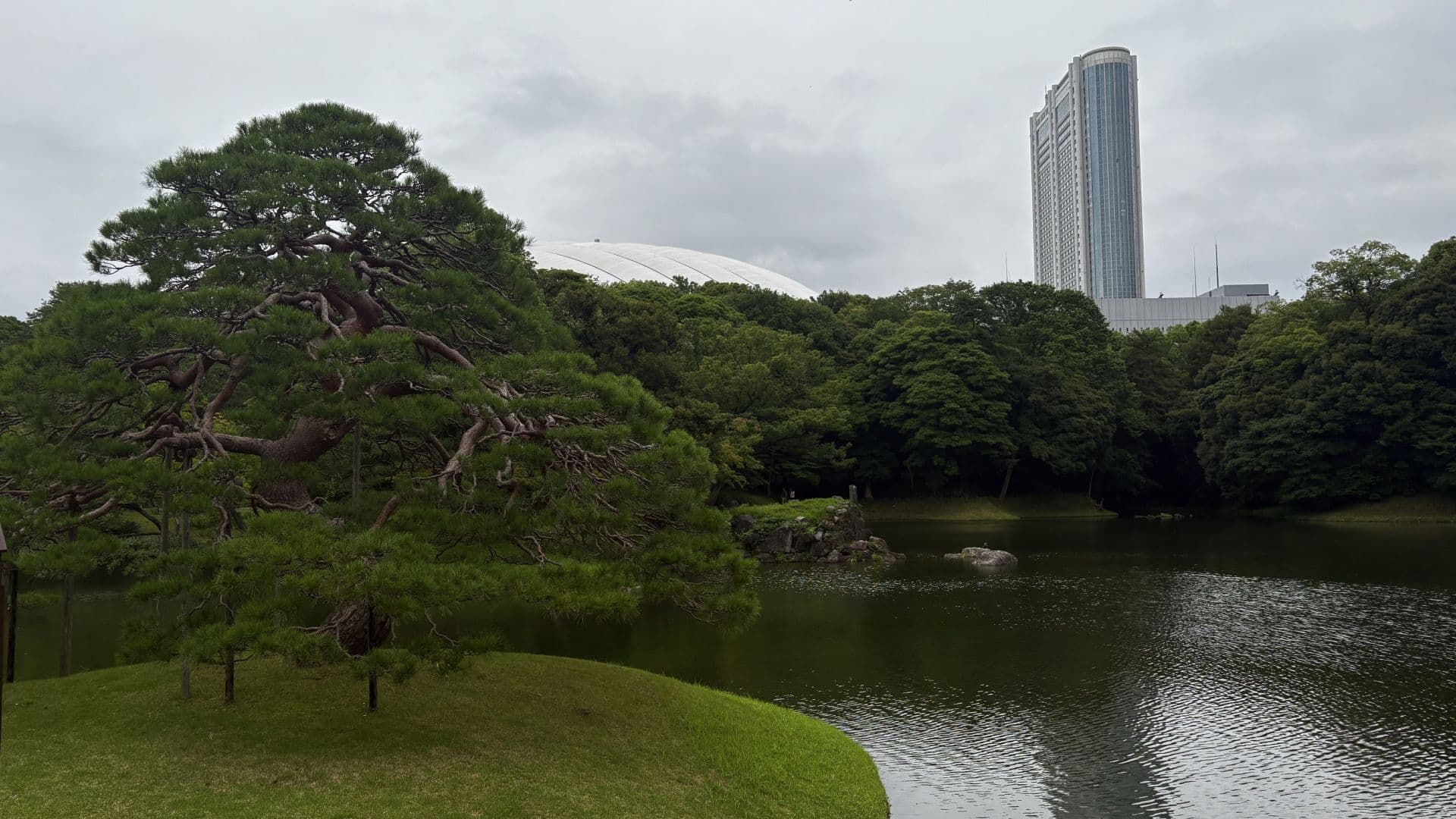
The garden is a strolling pond-and-hill garden centered on the great pond, Daisensui, read as a sea. Around it, scenes of mountains, rivers and rural countryside are arranged in a continuous circuit. The pond echoes the shape of Lake Biwa, with an island standing in for Chikubu Island. Borrowed and miniaturized scenes appear one after another: the Oi River and the red Tsuten-kyo bridge after Kyoto, the Otowa Falls, an embankment modeled on China's West Lake, and the Engetsu-kyo, a stone bridge whose reflection completes a full moon on the water's surface.
In the Edo period the garden's ponds were fed by the Kanda Aqueduct. It was rare for an aqueduct to run through a samurai residence, and traces of it remain today at the former aqueduct site.
A doubly designated masterpiece
In 1952 the garden was designated both a Special Historic Site and a Special Place of Scenic Beauty under the Law for the Protection of Cultural Properties. Only nine sites in Japan hold both designations together, among them Kinkaku-ji and Ginkaku-ji; among Tokyo's metropolitan gardens, only Hama-rikyu and Koishikawa Korakuen qualify.
With its plum grove, weeping cherries, rabbit-ear iris, Japanese iris and autumn maples, the garden changes through every season. Glimpsing Tokyo Dome beyond the historic scenery is itself a view that belongs to present-day Tokyo.