

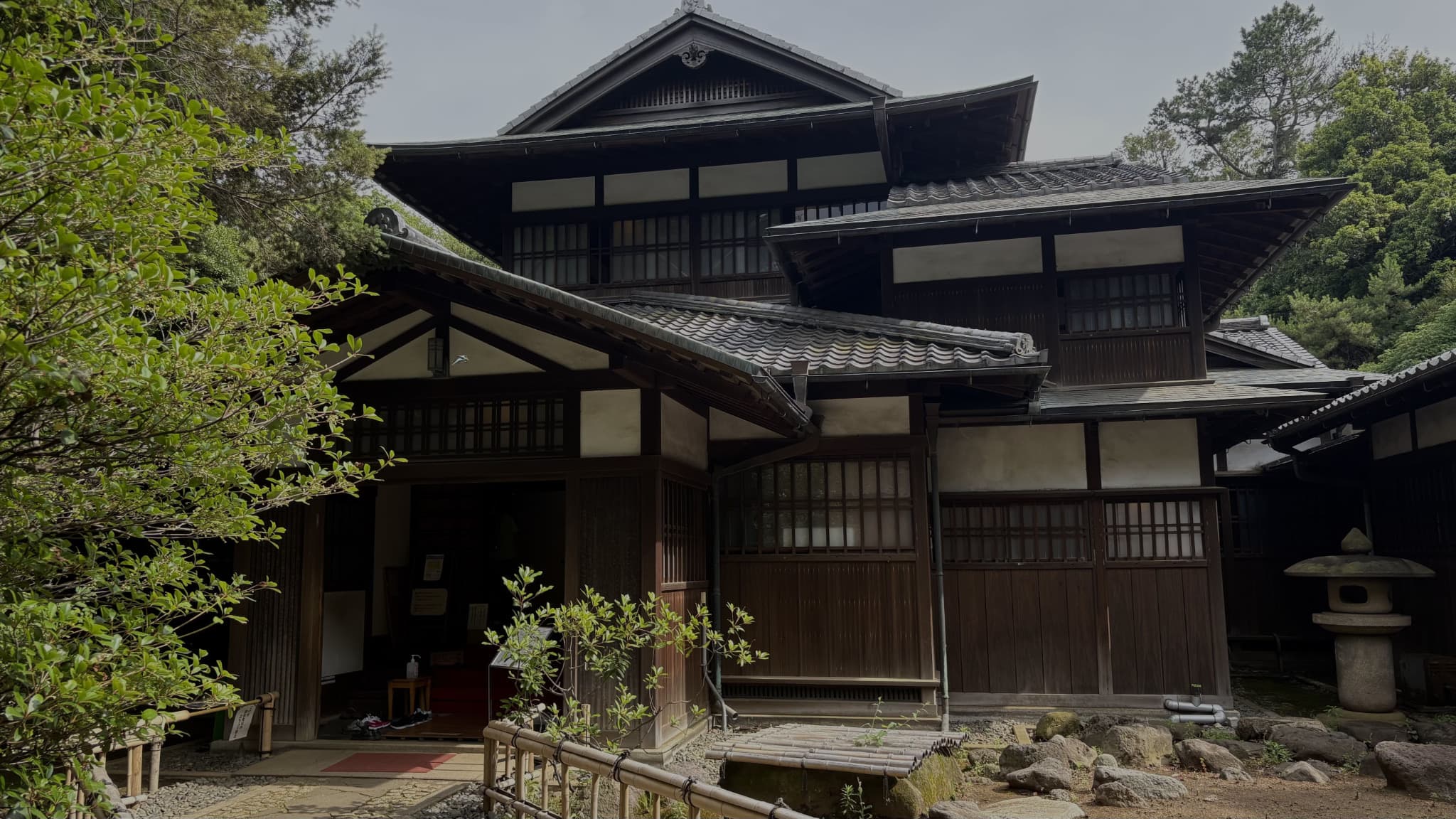
A great house of Kaga, relocated to Komaba
The Maeda family descended from the lords of Kaga, one of the wealthiest domains of the Edo period. Granted a marquisate under the Meiji peerage system, they kept their main residence in Hongo (today's University of Tokyo Hongo campus). After a land exchange with the Imperial University in the late Taisho era, the 16th head, Marquis Maeda Toshinari, planned a new residence on roughly 33,000 square meters in Komaba.
A three-story Western-style house (yokan) was completed in 1929, followed in 1930 by a two-story Japanese-style residence (wakan). Together they were called the finest mansion in the Orient. The overall plan was by Tsukamoto Yasushi; the Western house was designed by Takahashi Teitaro and the Japanese house by Sasaki Iwajiro, who also worked on Kyoto's Heian Jingu.
A house to live in, a house to host in
The Western house was self-contained, with service rooms allowing daily life to be conducted entirely within it, reflecting Toshinari's long years in Europe. The Japanese house, by contrast, was a dedicated reception building meant to convey Japanese culture to foreign guests, built to be shown rather than simply lived in. Door paintings by Hashimoto Gaho and finely carved transoms reveal the craftsmanship of the era. The tea room is said to be a faithful copy of Yuin, a celebrated Urasenke tea room, executed by Kimura Seibei.
The garden by Hara Hiroshi, seen from the veranda
The heart of the experience is the pond garden viewed from the engawa veranda. It was designed by Hara Hiroshi, a modern landscape gardener who also took part in creating the forest of Meiji Jingu. On-site signage notes its resemblance to the garden of Kyoto's Ginkaku-ji, with a composed yet varied arrangement. A sencha tearoom that once stood in this garden was later relocated to Seisonkaku beside Kenrokuen in Kanazawa.
Through half a century of change
After Marquis Toshinari died during the Pacific War, the estate was requisitioned by Allied forces and used as a commanders' residence. The Japanese house and part of the land became national property in 1956, and the site opened as Komaba Park in 1967, passing to Meguro City management in 1975. Both houses were designated Important Cultural Properties in 2013. The ground floor of the Japanese house has been open as a free rest area since 1974, where visitors can look out over the garden from the veranda.